Survive or Thrive? Why Strategic Planning Defines Success in Business and IT Transformation

Survive or Thrive? Why Strategic Planning Defines Success in Business and IT Transformation

If there’s one thing on the minds of most business leaders today, it’s uncertainty. From the rise of AI to geopolitical instability and shifting trade dynamics, leaders face growing pressure to respond boldly and act with clarity. According to KPMG’s AI Q3 2025 Pulse Survey, 82% of executives expect their industry to undergo significant changes within the next two years.

FAQs

Strategic Portfolio Management (SPM) is the practice of connecting business strategy to the portfolios of work, technology, and investments that deliver it. It helps organizations understand where resources are going, how projects align with strategic goals, and whether change efforts are delivering measurable business outcomes.

Transformation plans typically fail because they’re built on incomplete or disconnected information. Large enterprises have multiple systems, teams, and priorities operating in parallel, resulting in fragmented decision-making and unclear accountability. Without a unified view of dependencies and progress, it’s almost inevitable to lose momentum in execution.

Bizzdesign Alfabet provides a connected view of an organization’s entire IT and business landscape. It helps leaders link strategy to execution by mapping applications, technologies, and investments to business outcomes. With capabilities like AI-supported portfolio analysis, executive-ready reporting, and lean portfolio management, it enables faster, evidence-based decisions and higher return on transformation investments.


The State of Enterprise Architecture 2025

The State of Enterprise Architecture 2025

See how top-performing organizations turn strategy into results.
The State of Enterprise Architecture 2025 Bizzdesign

Discover the Advantage of Mature Enterprise Architecture Practices

Struggling to turn big-picture plans into real-world results? 
You’re not alone. 

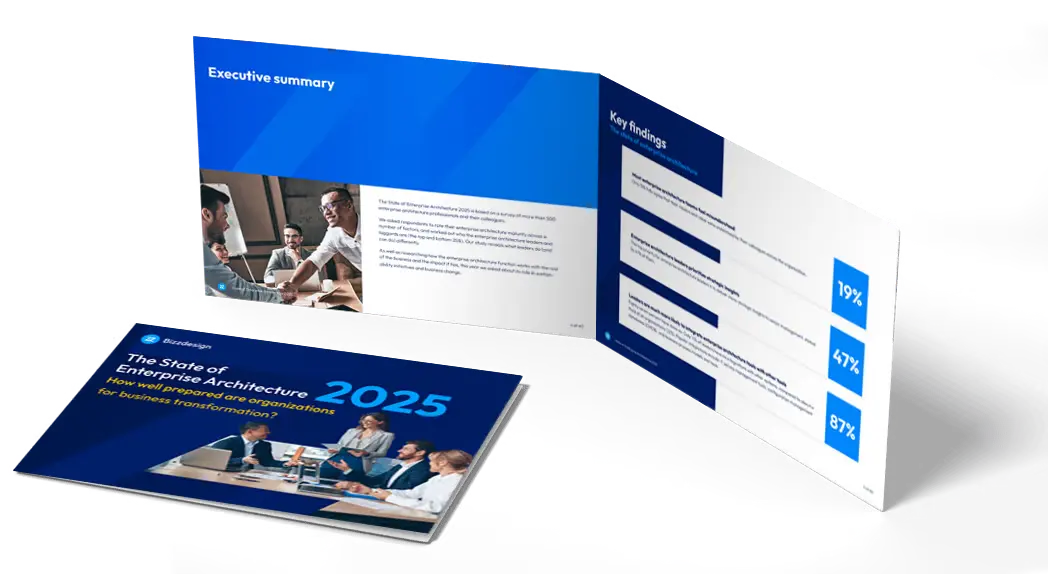
The State of Enterprise Architecture 2025 reveals how organizations with mature EA practices have deeper insights into their capabilities, invest more strategically, and can better share enterprise architecture information across the organization.
 

CAPTCHA

How Leading Organizations Elevate Business Value With EA

This 5th edition of the State of EA report gives you actionable benchmarks and proven practices to gain deeper insight into your capabilities by seeing how industry leaders map capabilities to strategy for smarter, more informed decisions. Learn how enterprise architecture–driven organizations prioritize investments by aligning funding with business value, ensuring greater impact. Understand the most common roadblocks to execution and how to overcome them effectively. Finally, discover how mature EA teams are taking the lead in IT sustainability and staying ahead with green IT initiatives.

Key findings in this year's report:

  • EA leaders have 1.8x better visibility into processes & information and are better at analyzing capability gaps.  
  • 47% of leaders prioritize strategic insights to senior management, highlighting EA’s evolving business focus.
  • 39% of leaders prioritize investment in EA resources, recognizing their critical role in driving agility and insight.

Download your copy to benchmark your organization and discover the trends, challenges, and strategies shaping enterprise architecture.


Empower Everyone with AI-Driven Access to Enterprise Data

Empower Everyone with AI-Driven Access to Enterprise Data

Oct 31, 2025 - Yannick Rudloff - AI in Enterprise Architecture & Transformation
Person using a smartphone to access information, representing simple, user-friendly access to enterprise data

Explore how Bizzdesign applies Model Context Protocol (MCP) to bring natural language queries to your EA data.

If you needed to know which applications deliver the most value, how transformation is progressing, or where your biggest risks lie, how long would it take? 

For enterprise architects, the answers already live in the enterprise architecture (EA) repository. For others across the business, they're often locked behind tools, formats, or language that make it harder to access.

That's what we set out to change.

FAQs

Model Context Protocol (MCP) is an open standard that defines a structured interface through which AI applications can interact with enterprise systems and data sources, as exposed by MCP servers.

In the context of enterprise architecture, MCP allows authorized users to ask questions in natural language through AI tools such as ChatGPT, Microsoft Copilot, and Claude. Those tools translate the request into structured queries against governed EA models. This makes it possible for business and technology stakeholders to explore applications, processes, capabilities, risks, and dependencies directly from the architecture repository, without needing deep architectural expertise. 

MCP enables AI to reason over complex enterprise contexts and insights, not just retrieve data. By linking AI assistants to governed EA data, teams can instantly surface dependencies, risks, and progress across applications, processes, and capabilities. This gives business and IT roles access to the same trusted, structured enterprise intelligence, helping them make confident, evidence-based decisions. 

MCP makes architectural intelligence accessible beyond the EA team. Business analysts, product owners, transformation leads, and other authorized users can interact with the enterprise model through AI without needing deep EA expertise.
It gives them secure, real-time access to trusted enterprise insights through the AI tools they already use, helping teams find answers and make decisions in seconds.

Behind the scenes, MCP is the enabler that connects data, AI, and people. It drastically scales the EA team’s strategic impact by reducing manual work, streamlining repetitive requests, and getting valuable insight into the hands of those who need it across the business.

MCP provides AI with direct access to enterprise architecture models, including applications, processes, capabilities, risks, and their relationships. Instead of inferring context from documents or dashboards, AI can query the architecture as a structured, governed system and evaluate dependencies, governance rules, and impact across the enterprise.


Bridging the Strategy-to-Execution Gap with Enterprise Transformation

Bridging the Strategy-to-Execution Gap with Enterprise Transformation
Oct 16, 2025 - Bert van der Zwan - Leadership
Strategy to Execution Gap Enterprise Transformation

When it comes to digital transformation, progress is still a steep climb for many. Recent studies show that 88% of transformation fall short of their ambitions while only a quarter of organizations qualify their efforts as truly successful. [1]

But after decades of investment, why is real impact still so rare? The answer lies in a persistent gap between strategy and execution. McKinsey research indicates that even high-performing companies deliver around 30% less value than their strategies promise. [2]

Why Transformations Fail 

When there's a disconnect between strategy and execution, it often stems from lacking a unified view of the organization, leading to fragmented decisions and lost value. 


Bizzdesign Recognized as a Leader in the 2025 Gartner® Magic Quadrant™ for Enterprise Architecture Tools

Media Contact

For media, analyst, and speaking inquiries, please contact us.

press@bizzdesign.com

Bizzdesign Recognized as a Leader in the 2025 Gartner® Magic Quadrant™ for Enterprise Architecture Tools

Oct 8, 2025

Bizzdesign, a leading enterprise transformation SaaS company, today announced that it has been named a Leader in the 2025 Gartner® Magic Quadrant™ for Enterprise Architecture Tools. This is the eighteenth consecutive year that Bizzdesign has been placed in the Leaders quadrant.

About Bizzdesign

Bizzdesign is a global enterprise transformation SaaS company. Through the merger of three industry leaders, Bizzdesign, MEGA International, and Alfabet, the company offers a comprehensive enterprise transformation suite that helps organizations navigate the complexity of digital business. With a data-driven and AI-powered approach, it accelerates transformation, from vision to value, by empowering teams to collaboratively plan, design, and govern change. 


Confirmation | Transform Together and Deliver Faster With Bizzdesign Unify

Confirmation | Transform Together and Deliver Faster With Bizzdesign Unify

You're One Step Closer to Transformation That Flows 

Thank you for your interest, your request has been successfully submitted.


Our team will connect with you shortly to better understand your goals and walk you through what Bizzdesign Unify can help you achieve. In the meantime, feel free to explore our latest resources.


 

ArchiMate Relationships Point in the Same Direction as the Enterprise

ArchiMate Relationships Point in the Same Direction as the Enterprise

Sep 26, 2025 - Marc Lankhorst - Enterprise Architecture
archimate relationships point in the same direction as the enterprise

When I give a presentation to a technical audience showing any kind of picture with an arrow in it (not necessarily an ArchiMate diagram), more often than not, someone will raise their hand and ask: “What does that arrow mean?” When I answer, they will follow up with “Shouldn’t it be the other way round?” Of course, when two things have a relationship you can always view that relationship from either end, so there is no ‘right’ way of choosing a direction; you have to make a conscious choice. In this blog, I want to clarify the choices on relationship directions that we made in the design of the ArchiMate language.

Serving

Perhaps the most contentious one is the ‘serving’ relationship (or ‘used by’ as it was called before ArchiMate version 3.0). This points from the element that provides some functionality to the element that consumes it. For example, in the figure below we see application services connected to a business process in this way. 

Summary

ArchiMate relationships may seem confusing at first, but their consistent design provides clarity once you understand the underlying principle: they always point toward enterprise goals and results. From serving to influence to assignment, the language reflects the journey from capabilities and resources to outcomes and drivers. For architects, keeping this in mind ensures models remain meaningful, aligned with strategy, and effective in guiding enterprise transformation.


FAQs

Because they emphasize the direction of service delivery—what is offered to the business or application process consuming it.

Influence points from the element providing impact toward the motivation element, aligning means with the ends an enterprise wants to achieve.

Always ask: Which end of the relationship is closer to the enterprise’s goals or desired outcomes? That’s usually the direction ArchiMate points.


Business Architecture With ArchiMate

Business Architecture With ArchiMate

Sep 28, 2025 - Marc Lankhorst - Enterprise Architecture
business architecture with archimate

Business architecture is becoming a critical discipline for organizations that need to adapt quickly to market volatility, regulatory pressure, and digital disruption. By using ArchiMate for business architecture, enterprises can bridge the gap between high-level strategy and operational execution. This modeling language provides a common framework to connect business models, capabilities, value streams, and outcomes with the supporting IT landscape. In this article, we explore how to apply business architecture with ArchiMate, supported by practical examples such as stakeholder analysis, ecosystem mapping, capability maps, and business outcome journey maps.

Why Business Architecture Matters in a Changing Environment

Today, organizations need to move at speed and adapt their business to a volatile environment, while at the same time dealing with many inside and outside stakeholders and influences, ranging from customers and partners in the ecosystem to regulators, competitors, and the uncertain effects of politics (viz. Brexit or the US-China trade war). 

Summary

Business architecture with ArchiMate provides a structured way to connect strategy, capabilities, and operations. By using models such as capability maps, business model canvases, stakeholder views, and value streams, organizations can align business goals with execution and maintain agility in a volatile environment. ArchiMate not only ensures consistency and traceability across the enterprise but also enables clear communication with both business and IT stakeholders. Leveraging these models helps enterprises innovate, manage change, and deliver sustainable value.


FAQs

Business architecture defines how an organization creates and delivers value by connecting strategy to execution. It focuses on capabilities, value streams, processes, and stakeholders.

ArchiMate provides a standardized modeling language that helps architects design, analyze, and communicate business architecture models, ensuring consistency and alignment with IT and operations.

Examples include capability maps, business model canvases, stakeholder analysis, ecosystem maps, and business outcome journey maps—all traceable to enterprise goals.

Business stakeholders are often not familiar with technical diagrams. ArchiMate allows for stakeholder-oriented views, ensuring that business and IT teams share the same understanding.