
Bizzdesign Unify: An AI-native platform for faster, better transformation decisions.
Bizzdesign Enters 2026 with Strengthened Market Position and AI-Driven Vision for Enterprise Transformation
Bizzdesign Enters 2026 with Strengthened Market Position and AI-Driven Vision for Enterprise Transformation
January 13, 2026
Following the successful integration of MEGA International and Alfabet, Bizzdesign reports strong market recognition and continued investment in innovation and talent
About Bizzdesign
Bizzdesign is a global enterprise transformation SaaS company, offering an end-to-end suite spanning Enterprise Architecture, Strategic Portfolio Management, Governance, Risk & Compliance, and Transformation Collaboration. Through a data-driven and AI-powered approach, Bizzdesign accelerates transformation from vision to value by enabling teams to plan, design and govern change collaboratively.
FAQs
Bizzdesign has received independent recognition from leading industry analyst firms including Gartner and Forrester, being named a Leader in the enterprise architecture space in The Forrester Wave™: Enterprise Architecture Management Suites, Q4 2024. The company was also named a “2025 Company of the Year” by the Business Intelligence Group. These recognitions reflect over two decades of innovation in the enterprise architecture market. Bizzdesign continues to strengthen its offering through increased investment in product development, expanded global reach, and AI-driven innovation, helping organizations bridge the strategy-to-execution gap with greater speed and confidence.
Bizzdesign’s solutions span Enterprise Architecture, Strategic Portfolio Management, Governance, Risk & Compliance, and more. Bizzdesign is the only provider to offer a true end-to-end enterprise transformation suite, supporting the full journey from strategy to execution. With integrated AI, Bizzdesign helps organizations make smarter investments, strengthen governance, manage risk effectively, and deliver measurable outcomes.
In 2025, MEGA and Alfabet came together with Bizzdesign under one brand. Their products, expertise, and resources are now fully integrated into Bizzdesign. Customers looking for MEGA or Alfabet solutions will find them on bizzdesign.com. To protect customer investments, Bizzdesign will maintain individual product roadmaps for the next five to seven years, while continuing to innovate on new industry-leading products.
In 2026, enterprise architecture becomes a central enabler of transformation rather than a supporting function. As AI, distributed systems, and regulatory pressure increase complexity, the challenge for leaders is ensuring the organization can scale change while maintaining coherence and governance. Enterprise architecture provides the structural clarity needed to align strategy, execution, data, and risk across the enterprise, enabling faster decision-making with confidence. Its role shifts from documentation to orchestration, helping organizations turn transformation from a series of initiatives into a repeatable, enterprise-wide capability.
In 2026, enterprise architecture evolves from a primarily descriptive discipline into an operational one, driven by the demands AI places on the enterprise. As AI introduces greater autonomy, speed, and interdependence across systems, leaders need real-time visibility into how decisions, data, and risks propagate through the organization. Enterprise architecture responds by becoming more dynamic and contextual, modeling AI agents, intelligent workflows, and their dependencies alongside traditional systems and processes. This shift allows organizations to embed governance, security, and accountability into design choices from the outset, enabling AI to scale safely while keeping strategy, execution, and risk aligned.
LEAP
LEAP
EU moves to simplify GDPR and AI Act obligations, raising compliance questions for companies
Date
Image
Image

Product Categories
Industry Category
Language
Resource Category
Resource URL
https://www.complianceweek.com/regulatory-policy/eu-moves-to-simplify-gdpr-and-ai-act-obligations-raising-compliance-questions-for-companies/36383.article
2026 Enterprise Transformation Outlook: A Q&A with Bert van der Zwan
2026 Enterprise Transformation Outlook: A Q&A with Bert van der Zwan




Enterprise Transformation Shifts That Will Define 2026
Enterprise Transformation Shifts That Will Define 2026
What 2025 Taught Us About Enterprise Transformation
Enterprise leaders are entering 2026 with no shortage of ambition, but far less tolerance for drift. After several years of sustained investment in AI, cloud, data, and security, boards and executive teams are no longer debating whether transformation is possible. They are asking a more demanding question: can it deliver consistent, measurable value at scale?
In many organizations, that pressure is most visible in one area: AI. Pilots and proofs of concept are no longer sufficient to demonstrate progress. Leaders now expect evidence that experimentation can translate into scalable operational outcomes, and that the organization itself is designed to absorb innovation at the pace the business requires.
The questions leaders ask are no longer, “Can AI work?” or “Should we modernize?”
It’s now, “How do we make this deliver measurable value, and how do we do it without losing control?”
The shifts shaping 2026 reflect this reality. They mark a new moment for enterprise transformation — one where long-standing architectural, governance, and portfolio disciplines are no longer optional, but central to delivering outcomes at scale.
The Three Shifts Shaping Enterprise Transformation 2026
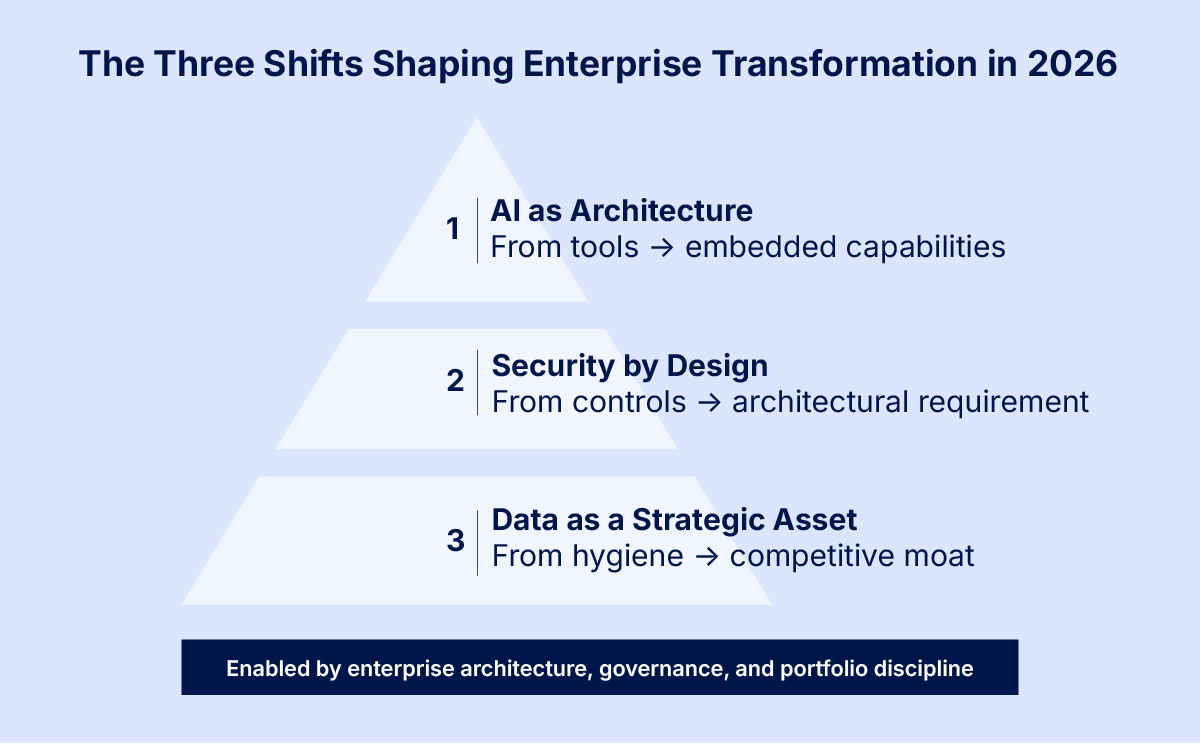
1. AI Moves to the Core of Enterprise Design
A clear divide is emerging between organizations that add AI onto existing ways of working and those that design AI into how the business actually runs.
FAQs
In 2026, enterprise architecture becomes a central enabler of transformation rather than a supporting function. As AI, distributed systems, and regulatory pressure increase complexity, the challenge for leaders is ensuring the organization can scale change without fragmenting or losing control. Enterprise architecture provides the coherence needed to align strategy, execution, data, and risk across the enterprise, enabling faster decision-making with confidence. Its role shifts from documentation to orchestration, helping organizations turn transformation from a series of initiatives into a repeatable, enterprise-wide capability.
Successful AI adoption depends less on deploying new tools and more on how AI is embedded into the enterprise. Enterprise architecture enables organizations to treat AI as an architectural design choice rather than a standalone solution by providing visibility into where AI creates value, how it interacts with existing systems and processes, and what dependencies or risks must be managed. By modeling AI alongside applications, data flows, and controls, enterprise architecture helps organizations avoid fragmented pilots and scale AI in a way that delivers measurable outcomes while remaining aligned with enterprise priorities.
To deliver consistent business value, AI must be designed into the architecture of the enterprise from the outset, embedded into workflows, systems, and governance structures. This means embedding AI into core workflows, modeling how intelligent agents interact with systems and data, and ensuring governance, security, and accountability are built in from the start. Enterprise architecture plays a critical role in making this possible, providing the visibility and structure needed to scale AI safely across functions and processes. In 2026, the organizations that succeed with AI will be those that architect it with coherence, not just speed.
In 2026, enterprise architecture evolves from a primarily descriptive discipline into an operational one, driven by the demands AI places on the enterprise. As AI introduces greater autonomy, speed, and interdependence across systems, leaders need real-time visibility into how decisions, data, and risks propagate through the organization. Enterprise architecture responds by becoming more dynamic and contextual, modeling AI agents, intelligent workflows, and their dependencies alongside traditional systems and processes. This shift allows organizations to embed governance, security, and accountability into design choices from the outset, enabling AI to scale safely while keeping strategy, execution, and risk aligned.
In 2026, regulations such as the EU AI Act will increasingly shape how AI systems are designed, extending governance into architectural and operational decisions from the start. Requirements around risk classification, transparency, and accountability mean that compliance can no longer be treated as a downstream activity. Organizations will need to embed governance, traceability, and oversight directly into their architectures and operating models. When this is done well, regulation becomes a catalyst for maturity, giving leaders the confidence to scale AI responsibly rather than slowing innovation.
In 2026, executives should prioritize the foundations that make transformation scalable and sustainable, including enterprise-wide design choices that determine how technology delivers value. That means investing in real-time visibility, governed data, embedded security, and a shared understanding of how value flows through the organization. By designing operating models that support autonomy without losing control, embedding AI and security into architectural design choices, and treating data quality as a strategic asset, leaders can ensure that innovation flows through the enterprise in a consistent, governed way. When strategy, execution, and governance are aligned, transformation moves faster — with greater confidence and impact.


Club Décision DSI
Club Décision DSI
Bizzdesign Connect Paris 2025
Bizzdesign Connect Paris 2025
Bizzdesign Connect LATAM 2026
Bizzdesign Connect LATAM 2026
¡Gracias por registrarte al Bizzdesign Connect LATAM 2026!
Tu registro ha sido confirmado.
Pronto recibirás en tu correo electrónico los detalles para unirte a la sesión.
Nos vemos pronto,
El equipo de Bizzdesign
AVIS D’EXPERT – Pourquoi la transformation numérique continue d’échouer et comment faire pour y remédier
Date
Image
Image

Product Categories
Industry Category
Language
Resource Category
Resource URL
https://www.solutions-numeriques.com/avis-dexpert-pourquoi-la-transformation-numerique-continue-dechouer-et-comment-faire-pour-y-remedier/
Why Digital Transformation Still Fails, and What It Takes to Get it Right
Date
Image
Image

Product Categories
Industry Category
Language
Resource Category
Resource URL
https://www.financederivative.com/why-digital-transformation-still-fails-and-what-it-takes-to-get-it-right/