Planning and Roadmapping Modeling in ArchiMate

Planning and Roadmapping Modeling in ArchiMate

Sep 25, 2025 - Marc Lankhorst - Enterprise Architecture
planning and roadmapping modeling in archimate

In our previous blog post on planning and roadmapping, we introduced the concept in the context of enterprise architecture and capability-based planning. We explored different levels of roadmaps, from short-term sprints lasting just a few weeks to long-term, multi-year strategic roadmaps, and shared initial insights into how ArchiMate® conceptscan be used for roadmap modeling.


In this article, we take a closer look at the different ways to model the evolution of your architecture, providing more practical guidance for creating effective roadmaps that support transformation initiatives.

Modeling roadmaps with plateaus

The most prominent feature of the ArchiMate language is the Plateau concept. In the standard, this is defined as: “a relatively stable state of the architecture that exists during a limited period of time.” 

This concept intends to model fairly major changes to your architecture, hence the ‘relatively stable’; small-scale changes are too frequent to lend themselves easily for collecting them in plateaus. 


Linking Capabilities to the Operating Model Business Functions and Organizational Structure

Linking Capabilities to the Operating Model Business Functions and Organizational Structure

Sep 26, 2025 - Marc Lankhorst - Enterprise Architecture
 Name linking capabilities to the operating model business functions

Editor's Note: Business Capabilities are fundamental to Business Architecture, making it essential to understand how to implement them effectively. To help you navigate Capability-Based Planning, we've created the ultimate eBook, packed with insights, strategies, and practical guidance to set you on the right path. This blog post is an excerpt from the eBook, providing a glimpse into the valuable content you'll find inside.

How they relate: Capabilities, Business Functions, the Organization

In this blog, we want specifically to answer the question: How does the enterprise’s operating model deliver capabilities? Let’s start by clearing up an important misunderstanding: a Capability Map is not a functional decomposition of the enterprise!

Summary

Linking business capabilities to the operating model provides a clear line of sight from strategic intent to operational execution. By distinguishing between capabilities and business functions, and relating them to organizational units, processes, and technology, business architects can build models that are both strategic and actionable. This capability-driven perspective ensures that enterprises stay focused on what they can do, while functions and resources define how they achieve it—creating flexibility, traceability, and long-term business value.

FAQs

Business capabilities describe what an enterprise can do, while business functions describe how these capabilities are performed in practice.

It ensures alignment between strategic goals and day-to-day operations, providing clarity and traceability across people, processes, and technology.

While they are often confused, it is best to use capability maps for high-level abilities and business function maps for operational detail to avoid redundancy.


How to Combine ArchiMate® With Industry Standards for Better EA

How to Combine ArchiMate® With Industry Standards for Better EA

Sep 27, 2025 - Marc Lankhorst - Enterprise Architecture
combining archimate with other standards

The ArchiMate® modeling language becomes even more powerful when combined with other enterprise architecture and business standards. 

By integrating ArchiMate with frameworks such as TOGAF®, BPMN, or UML, organizations can achieve richer models, improved consistency, and stronger alignment between strategy, processes, applications, and technology. 

This synergy enables enterprise architects to create more comprehensive views, support collaboration across disciplines, and deliver greater value to transformation initiatives.

What is the ArchiMate modeling language?

ArchiMate is an open, standardized modeling language for enterprise architecture. It provides a unified framework for describing, analyzing, and visualizing connections across business domains. It offers a clear, consistent way to capture and communicate complex organizational relationships. 

The ArchiMate language is not intended to replace other standards and modeling approaches. For many domains, languages, and techniques are available that provide more detailed descriptions. 

Summary

First of all, let’s repeat what we started with: ArchiMate is not intended to replace other standards and techniques but rather to complement them. For many domains, there are languages and techniques available with a narrower scope but a greater level of detail. ArchiMate provides a broader description that helps to see the dependencies between different aspects and areas and gives a general overview of your enterprise. 

It can connect to those other techniques because their concepts overlap. Since ArchiMate is only a modeling language, it does not provide its way of working, but it will, of course, be used in the context of such a process. Much has been written about using ArchiMate with TOGAF—both Open Group standards and easily complementary—and we did not want to repeat that in this blog. 

In addition to this typical use in enterprise architecture, we discussed the relevance of architecture and ArchiMate in agile development. Although the role of models in an agile approach differs from the traditional ‘big design up front’ development style, they are important in ensuring coherence across different timescales, iterations, and domains. 

You need to make sure that agile teams work with and not against each other and avoid creating silos, and you want to align everyone from strategy to operations with the same purpose. 

Creating, evolving, and sharing just-in-time models that capture the information necessary to make the right decisions at all levels of the organization at the right moment is the best way to become a truly adaptive enterprise. If you have any further questions about linking ArchiMate to other standards, please contact us.


The Future of Enterprise Architecture and AI Integration

The Future of Enterprise Architecture and AI Integration
Oct 27, 2023 - Bizzdesign - Enterprise Architecture
the future of enterprise architecture and ai integration

‘The future of enterprise architecture’ is increasingly intertwined with Generative AI, which isn't merely a fleeting trend. Generative AI is a transformative tool that can diagnose medical conditions by predicting machinery failure or directing traffic and goods flow. Moreover, its symbiotic relationship with machine learning (ML) reshapes IT structures and enterprise architecture.

Future of enterprise architecture in the Generative AI era. 

Having a legacy spanning over three decades, enterprise architecture now faces the formidable task of navigating the burgeoning field of AI. The rapid technological advancements require enterprise architects to be nimble in recognizing potential trends, implementing transformative processes swiftly, and handling vast data volumes with finesse. 


ArchiMate® 3.0 – Grouping and Junctions

ArchiMate® 3.0 – Grouping and Junctions
Sep 22, 2025 - Marc Lankhorst - Enterprise Architecture
archimate 3 grouping and junctions

In our previous blog, we outlined some of the most important changes in relationships in ArchiMate® 3.0. But there is more. In this article, we discuss updates related to the Grouping and Junction concepts in the ArchiMate modeling language. These improvements significantly enhance the expressive power of enterprise architecture models.

Groupings in ArchiMate 3.0

By popular demand, the option to use relationships to or from groupings has been added to ArchiMate, which greatly enhances the practical value of this element. 

Grouping is no longer classified as a special kind of relationship: it is now a (composite) element. Composition or aggregation relationships from a grouping to an element or relationship are used to model that these concepts are part of the grouping (nesting is often used as an alternative notation for this). 


Busines Model Examples With the Business Model Canvas

Busines Model Examples With the Business Model Canvas

Sep 27, 2025 - Bizzdesign - Enterprise Architecture
Busines model examples with the business model canvas

The Business Model Canvas is a practical tool to understand how your business creates, delivers, and captures value. In this article, we explore how analyzing your business model can help answer key questions about revenue, costs, and opportunities for improvement. Using a fictional case study, you’ll see how to apply this analysis and why the right tools make a difference.

Business Model Analysis

The Business Model Canvas is useful for describing how a business captures, creates, and delivers value. In this blog, we will elaborate on Business Models, introducing the subject of Business Model Analysis. Analyzing your business model can help to determine whether a venture is, or will be, viable and valuable.

Conclusions and next steps

We described types of analysis, and we zoomed in on analyzing the Business Model Canvas. Analysis of business models answers the question of why and how a venture is or will be, viable and valuable. Based on questions that represent various perspectives on analyzing business models, the Nextpresso case illustrates different approaches to conducting analysis. Choosing the right enterprise architecture tool is essential for business model analyses, making calculations and communication easy. If you would like to see a demo of the Business Model Canvas in Bizzdesign, please contact Bizzdesign's experts for a demo.
FAQs

It helps organizations assess viability, identify strengths and weaknesses, and explore scenarios for growth or transformation.

By visualizing relationships between elements, organizations can test new value propositions, channels, or customer segments before implementation.

Tools like Bizzdesign enable scenario comparisons, cost/revenue calculations, and integration with downstream models (e.g., processes, customer journeys).


5 Process Models Examples and Benefits

5 Process Models Examples and Benefits

5 process models and examples

Topic: Business process management focuses on how the enterprise operates and delivers the results i.e. products and services to external and internal customers. 

Process models represent an abstract view of a business process and serve as a blueprint for implementing or improving it. A process model describes how the process works, what steps are involved, and how those steps are performed. 

Process models can be designed in business process management software or enterprise architecture platforms. We advise and promote designing business processes on an enterprise architecture platform, such as Bizzdesign Horizzon, because it helps you to design and execute transformations effectively. The benefits of this are described below.

Benefits of business process models (and examples)

Transparency 

Process models help everyone understand the processes that exist within an organization and identify who is responsible and accountable for each activity. It also allows employees to understand the bigger picture better and how their work influences the outcomes and the work of others.
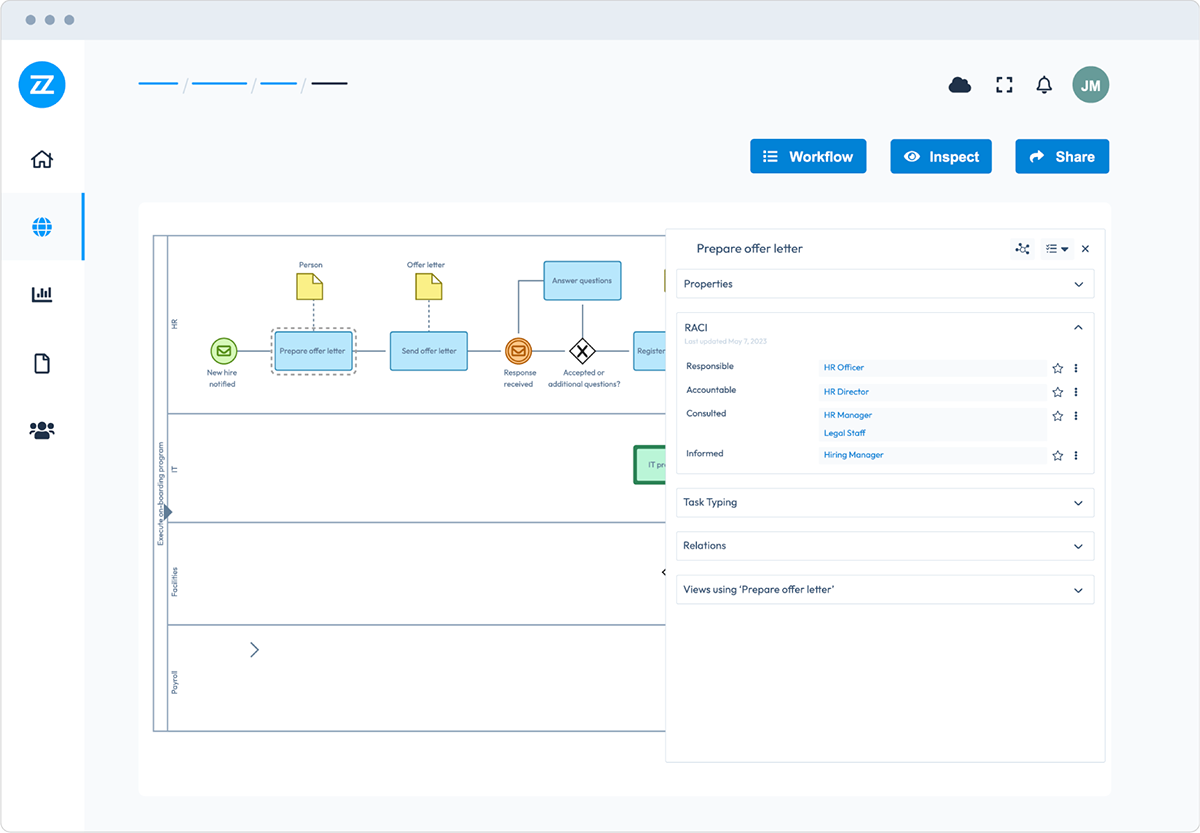

figure 01

Summary

Business Process Management (BPM) empowers process teams with a guided framework for designing, modeling, and managing enterprise-wide process architecture. It includes ready-to-use framework templates and interactive management dashboards that align operational processes with strategic business goals. With this solution, teams can model processes at multiple levels of detail, seamlessly integrated with the broader enterprise architecture to gain critical insights and drive successful transformation initiatives.


Measuring Business Capabilities for Successful Transformation

Measuring Business Capabilities for Successful Transformation

Sep 21, 2025 - Marc Lankhorst - Enterprise Architecture
How To Measure Business Capability Aspects So You Can Execute Your Organization’s Transformation Strategy?

To effectively assess a business capability and execute Capability-based Planning, we need to define and measure three dimensions: Strategic Importance, Capability Maturity, and Adaptability. 

Simply put, the first dimension lets you prioritize those capabilities that are most important to your enterprise; the second focuses on where improvement may be needed because the current maturity is too low; and the third looks at how easy or difficult it will be to make that improvement. 


The three dimensions that help us assess Business Capabilities are:

  • Strategic Importance: How relevant or critical is a capability for the success of the business? This is determined in terms of its contribution to strategy execution, to the business or operating model, and to the future opportunities it provides.
  • Capability Maturity: How good are we at performing this capability?
 

Business Capabilities vs. Business Functions: Same Difference?

Business Capabilities vs. Business Functions: Same Difference?

Sep 27, 2025 - Marc Lankhorst - Enterprise Architecture
capabilities vs business functions same difference

Enterprise architecture is an essential instrument in improving the capabilities of your organization's functional business units. In recent years, Business Capability and Capability-based Planning have become popular and important in enterprise and business architecture. However, this concept is also confusing, particularly for those familiar with a similar idea of business function. In this blog, I want to clarify some of this confusion. 

The origins of the business function concept

In the world of engineering, the notion of functional decomposition has a long history, dating back to at least the fifties in information systems design and much further in other engineering disciplines, with roots in mathematics and philosophy. 

Applied to organizations, this has led to the concept of a business function in enterprise architecture: a coherent set of activities that describe what a business does. 

FAQs

Business capabilities describe what an organization is able to do (its potential), while business functions describe what an organization actually does in terms of activities.

Capabilities provide a strategic, implementation-independent view of an organization’s strengths and potential, making them a key instrument for planning transformation and aligning with business strategy.

Yes. In many cases, a capability has corresponding business functions that realize it. However, they don’t always match one-to-one because capabilities are broader and more strategic in scope.

Organizations often create capability maps to identify strategic strengths, gaps, and investment priorities. Capabilities help in transformation planning, portfolio management, and assessing maturity.

Not necessarily. Best practice is to use capabilities at a high level (to capture strategic potential) and business functions at a more detailed level (to capture concrete execution activities).


Solution Architecture Design: Guide for Modern Enterprises

Solution Architecture Design: Guide for Modern Enterprises

solution-architecture-design

Discover the intricacies of solution architecture design. Learn about the relationship between design and decision-making to solve complex problems.

Definition

Solution architecture design is crucial as it ensures the architecture is suitable for its intended purpose. This process involves collaboration and gathering information from various stakeholders, including business and development teams.

Reliable designs provide blueprints for new projects, which often start from scratch. In digital transformation, effective design aids in change management and boosts an organization’s capability to adapt to change.